

or


Why Does Tyre Pressure Drop When the Cold Arrives – and Why You Shouldn’t Ignore It
12-11-2026 11:29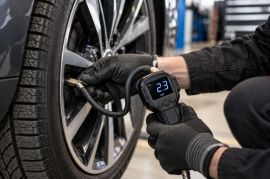
When the cold weather arrives, many drivers notice the tyre pressure warning light coming on even though none of the tyres is damaged. The reason is simple physics: tyre pressure drops by about 0.1 bar for every 10-degree fall in temperature.
Pressure that is too low lengthens braking distances, worsens handling and increases fuel consumption and tyre wear. We explain why pressure drops in winter, what it leads to and how to check your tyre pressure correctly in cold weather.
In autumn and winter, the tyre pressure warning light is a familiar sight for many drivers – especially on cold mornings. It often seems to come on for no reason, because it goes out after a short drive or the tyres look perfectly fine. In fact, the car is signalling a real problem: there is less air in the tyres than there should be, and this directly affects driving safety.
Why does tyre pressure drop in the cold?
The air inside a tyre contracts in the cold, and its pressure falls. According to Nokian Tyres’ experts, tyre pressure drops by about 0.1 bar for every 10-degree fall in temperature. The tyre doesn’t need to be damaged or the valve leaking – cold weather alone is enough.
An example: if the tyres were inflated to the correct 2.4 bar in a warm garage at +20°C, the pressure outside at –10°C will be only about 2.1 bar. In harder frost the gap is even bigger. Because temperatures in Estonia often swing by tens of degrees in autumn and winter, tyre pressure changes constantly too.
In addition, all tyres naturally lose a little air over time. If the pressure was last checked in summer or during a tyre change in a warm workshop, it may already be noticeably below the recommended level once the cold sets in.
What does low tyre pressure lead to?
Half a bar sounds like a small number, but its effect on driving is significant:
Longer braking distance. According to ADAC, even slight under-inflation can lengthen braking distances and worsen cornering behaviour – especially on wet roads. In tests by Germany’s TÜV association, a car with tyres 30% under-inflated needed up to six metres more to stop on a dry road.
Poorer handling. A tyre with too little pressure is too flexible and responds sluggishly to steering. According to Nokian Tyres’ experts, this can cause the rear of the car to slide in a sudden evasive manoeuvre.
Higher fuel or electricity consumption. ADAC estimates that pressure about 0.4 bar too low increases fuel consumption by up to 0.3 litres per 100 km. In an electric car, the range drops in the same way – and it is already lower in winter.
Faster and uneven wear. An under-inflated tyre wears faster at the shoulders and heats up more while driving.
Tyre and rim damage. The sidewall of an under-inflated tyre flexes more, which increases the risk of impact damage and failure. In hard frost, an under-inflated tyre can even come off the rim, for example after hitting a kerb.
A pressure sensor is no substitute for checking
Since November 2014, all new passenger cars registered in the EU must be fitted with a tyre pressure monitoring system (TPMS). It is a useful aid, but it has its limits. Many systems do not measure pressure directly; instead they compare wheel rotation speeds and only warn you once the pressure has already dropped noticeably. If the pressure falls evenly in all four tyres in the cold, such a system may not always detect it.
That is why Continental, for example, recommends checking tyre pressure about every two weeks in winter – even if your car has pressure sensors. On many cars the system also needs to be recalibrated after inflating the tyres; you will find instructions in the owner’s manual.
How to check tyre pressure correctly in winter
Find the correct pressure. It is listed on the driver’s door pillar, the fuel filler flap or in the owner’s manual. It may depend on load and tyre size.
Measure cold tyres. The best time is in the morning before driving, or at least a couple of hours after a drive. A tyre warmed up by driving shows a higher pressure than it really has.
Take the temperature into account. If you inflate your tyres in a warm garage or car wash, the pressure outside in the cold will be lower. Measure and inflate at the outdoor temperature whenever possible.
Use an accurate gauge. Petrol station equipment is convenient, but your own digital gauge is often more accurate.
Check the valve caps too. The cap protects the valve from moisture and freezing.
Repeat regularly. In winter at least once a month, and more often when the cold sets in and before longer journeys.
Should you put more air in your tyres in winter?
Many tyre manufacturers and motoring clubs recommend running winter tyres at about 0.2 bar above the car manufacturer’s recommendation to compensate for temperature swings. Nokian Tyres’ experts explain that this keeps the pressure from dropping too low in changeable weather. Moderately higher pressure is safer than pressure that is too low.
Don’t overdo it, though: excessive pressure reduces the tyre’s contact patch with the road and can weaken grip and lengthen braking distances. If the car is heavily loaded or towing a trailer, follow the manufacturer’s pressure figures for a loaded vehicle.
Studded and studless tyres and electric cars
Correct pressure is important for all winter tyres. With studded tyres, it ensures that the tyre and its studs meet the road as the manufacturer designed them to. Studless winter tyres grip the road using thousands of sipes and a soft rubber compound, which work best with the correct contact patch.
Electric cars deserve particular attention, as they are heavier than conventional cars and put more load on their tyres. Under-inflation affects both their range and tyre wear. Read more in our tips on electric car tyres.
Summary
A drop in tyre pressure in the cold is completely normal, but that doesn’t mean it can be ignored. A couple of minutes once a month keeps braking distances shorter, the car easier to control and fuel consumption lower, and it extends the life of your tyres.
If your tyres wear unevenly even at the correct pressure, the cause may lie in the suspension – in that case it is worth having a wheel alignment done. Before winter, it is also worth checking your tyres’ tread depth.
At Rehvid Pluss workshops, we also set your tyres to the correct pressure during a tyre change. Book your appointment here.

View location on the map
M-F - 08:30 - 17:30
Sa, Su - Closed
Phone: +372 5666 6019

View location on the map
M-F - 08:30 - 17:30
Sa, Su - Closed
Phone: +372 5552 5655

View location on the map
M-F - 08:00 - 18:00
Sa, Su - Closed
Phone: +372 5666 9616

View location on the map
M-F - 08:00 - 18:00
Sa - 10:00 - 15:00
Su - Closed
Phone: +372 5558 5471

View location on the map
M-F - 08:00 - 17:00
Sa, Su - Closed
Phone: +372 5666 4842

View location on the map
M-F - 08:30 - 17:30
Sa, Su - Closed
Phone: +372 5666 6423


